by David Schek | Nov 11, 2014 | Workers Comp, Workers' Compensation Insurance
The best thing to do to keep your Workers Compensation rates low is NOT to have accidents. The second best thing to do is to use light duty work effectively as a way to reduce your workers compensation costs.
Here is a great article that lists six tips to reduce your workers compensation expense through proactive management of your light duty program.
— http://www.thestaffingstream.com/2014/10/14/no-free-loaders-the-answer-to-fraudulent-workers-comp-claims-part-2/
Please feel free to contact me to discuss your staffing workers compensation issues. I would be glad to share some possible new staffing workers compensation programs that can lower your rates.
All the best
David Schek
President
www.StaffingCompSolutions.com
American Staffing Association Member
ASA Exhibitor 2014 Conference Booth 1123
California Staffing Association Member
StaffingCompSolutions.com—- Workers Compensation Specialists and Staffing Business Consultants For Over 25 Years.
by David Schek | Nov 3, 2014 | Staffing Company, Workers Comp, Workers' Compensation Insurance
In October, the Work Comp Staffing Solutions team met hundreds of staffing professionals at the American Staffing Association’s annual conference. Many attendees were interested in the Affordable Care Act’s impact on the staffing industry. In almost all of our conversations with staffing owners, there was an intense interest in the whether the ACA will increase or reduce workers’ compensations costs.
Here are some of the questions that we fielded:
- Will workers compensation benefits be delivered slower to employees because of the limited supply of doctors and emergency rooms that will now be servicing new ACA patients too?
- Will the limited health resources in the US, translate into to higher comp costs to employers as employees are out of work longer?
- Since under the ACA, employers receive a discount for wellness programs, will that translate into lower workers’ compensation costs?
And believe me, there were plenty more very interesting questions that were raised by the attendees.
Here is a picture of me speaking to a staffing owner about these issues and his recent increase in his rates.
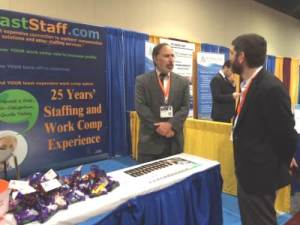
Please feel free to contact me with your questions about workers compensation in 2015 and I would be glad to address them, and provide a FREE workers compensation quote to you.
All the best
David Schek
President
david@StaffingCompSolutions.com
www.StaffingCompSolutions.com
American Staffing Association Member
ASA Exhibitor 2014 Conference Booth 1123
California Staffing Association Member
StaffingCompSolutions.com—- Workers Compensation Specialists and Staffing Business Consultants For Over 25 Years.
by David Schek | Sep 2, 2014 | Tips, Workers Comp, Workers' Compensation Insurance
Very often, staffing company owners are so busy putting out daily staffing fires, that they do not have time to thoroughly investigate workers compensation claims. Unfortunately these claims, that start out as smoldering tinders- when not managed properly, can turn in to a financial firestorm for the company down the road.
As Ben Franklin would say: An ounce of prevention is worth a pound of cure. The time it takes investigating all work comp accidents, can pay huge dividends for the staffing company.
Below is a great article about how to best investigate and manage work comp accidents so that “small fires” do not grow into huge financial disasters for your company. The author is Author Michael B. Stack, CPA, who is a Principal, Amaxx Risk Solutions, Inc. which is an expert in this field.
Why Should I Investigate?
Before a claim handler begins the investigative process, it is important to understand there are reasons why they are looking into the claim. Determining where you are procedurally can make the investigation more cost effective.
- Mitigating an accepted claim
- Defending a Potential Claim;
- Identifying Fraud; and
- Determining Other Necessary Parties to an Action
Determining Witnesses
Basic claims investigation will also allow you to determine witnesses. This will include fact or lay witnesses, as well as expert witnesses that may be necessary. Types of fact or lay witnesses include the following: managers or other supervisors, co-workers, on-site medical personnel, human resources staff, risk and safety managers and witnesses to the incident or injury.
Expert witnesses should be used at the discretion of a claims handler. Expert witnesses charge a fee for their services and may not be needed in all cases. Types of expert witnesses in a workers’ compensation claim include IME doctors, vocational experts and labor market surveys.
Other Sources of Documentary Evidence
Obtaining additional information about a claim is typically crucial in the early stages of a claim investigation. It is also important to know the law of the jurisdiction you are in as this will govern your ability to obtain information. For example, if an employee reports a work injury, claims management professionals are able to request authorizations for medical records. On the other hand, when a denial is made, the ability to access that same information may sometimes be only made once after a claim is put into litigation. State workers’ compensation acts and rules also govern employee statements, and access to other information.
Here is a list that claims handlers might want to access during a claims investigation:
- Authorization to obtain various records: medical, workers’ compensation division records, vocational reports, tax records (self-employment or multiple job wage earners), school records and unemployment records
- ISO Claims Bureau Search
- Maps and charts
- Police records
- Court records
- Medical records, bills and other expenses
- Child support obligations
- Internet or Social Media research
- Unemployment records
Other Sources of Information
It is also essential that the claims professional learns as much as they can about the employee’s work activities with the employer. In some cases it may be important to do the following:
- Videotape job site
- Videotape employee’s job (common in repetitive movement-type injuries)
- Security camera video
Questions of Admissibility
Just because you are able to find information, does not mean that it will be admissible at a workers’ compensation hearing. In order for a court to review evidence, it must be admissible. Rules regarding admissibility vary from state to state. The basic question most courts will ask is whether the evidence has probative value and is not overly prejudicial. Most states have relaxed rules of evidence in administrative settings. It is important to consult with an attorney on issues of evidence and admissibility.
Conclusions
Claims management teams are on the front lines when it comes to investigating a claim. Before handling any claim, it is important for a claims handler to understand what goals they are trying to accomplish and how to complete the task in an effective and timely manner.
I hope you found this article as useful and had a restful Labor Day. Please feel free to give me a call to discuss difficult workers compensation issues you have and together we determine economical ways to solve them. Also let me know if I can provide you with a FREE quote- just contact me at david@StaffingCompSolutions.com and visit our web site at www.StaffingCompSolutions.com
All the best
David Schek
President
StaffingCompSolutions.com
American Staffing Association Member
ASA Exhibitor 2014 Conference Booth 1123
California Staffing Association Member
StaffingCompSolutions.com—- Workers Compensation Specialists and Staffing Business Consultants For Over 25 Years.
by David Schek | Aug 18, 2014 | Workers Comp, Workers' Compensation Insurance
To be filed under “now I have heard everything….”
Downey, CA (WorkersCompensation.com) – Aurora Barrera, 33, of Downey, CA was arrested on charges related to her allegedly submitting a fraudulent workers’ compensation claim for treatment of post-traumatic stress disorder associated with a robbery, that she actually assisted in staging, at a bank where she worked as an assistant bank manager.
“This conspiracy led to a major law enforcement response, including the bomb squad,” said Insurance Commissioner Dave Jones. “It’s shocking to think that, Barrera, a trusted financial institution manager would be a co-conspirator in a bank robbery and staged kidnapping, and then have the audacity to file a bogus workers’ comp claim for traumatic stress and believe she could get away with it.”
On the morning of September 4, 2012, Barrera claimed she was held hostage by two men, forced to wear a bomb and told to drive to a Bank of America branch in East Los Angeles where she was employed. Barrera claimed she was given instructions to remove money from the bank vault and place it outside the building, which she did. The bank robbery resulted in a massive response by local, state and federal law enforcement, including the bomb squad who determined the device strapped to Barrera was a fake bomb.
Two days after the robbery, Barrera submitted a workers’ compensation claim for post-traumatic stress disorder. Barrera began receiving medical treatment and collected approximately $2,453 a month in temporary total disability benefits. The total amount of benefits paid out to Barrera totaled $35,573. An additional $9,964 was incurred in medical and other insurance expenses.
An FBI investigation determined that Barrera was a knowing participant in the bank robbery. As a result Barrera was arrested and subsequently convicted for the bank robbery, along with her then boyfriend and two others. Barrera was sentenced on August 6, 2014 in Federal Court to nine years in federal prison and was given until September 8 to surrender.
Since Barrera was involved in the robbery, the workers’ compensation claim was considered to be fraudulent. The subsequent criminal investigation by the Department of Insurance, in cooperation with the FBI, resulted in an arrest warrant for Barrera for charges of insurance fraud, burglary and grand theft. Barrera was arrested without incident at her residence in Downey and booked into the Los Angeles County Jail.
Barrera faces a maximum sentence of five years in state prison.
I had to read this a few times to appreciate the audacity of this workers compensation fraud. I think it takes workers compensation fraud to a new low. I would love to hear about any interesting workers compensation stories you may have. In additional I am always available to discuss your workers compensation rate challenges (as long as they do not involve bank robberies) and offer you a quote for a more competitive program
You can reach me at david@StaffingCompSolutions.com and visit us at www.StaffingCompSolutions.com
All the best
David Schek
President
StaffingCompSolutions.com
American Staffing Association Member
ASA Exhibitor 2014 Conference Booth 1123
California Staffing Association Member
StaffingCompSolutions.com—- Workers Compensation Specialists and Staffing Business Consultants For Over 25 Years.
by David Schek | Aug 12, 2014 | Warehouse Safety, Workers Comp, Workers' Compensation Insurance
OSHA audits can impact your clients at any time. Whether your client is a manufacturing facility, a warehouse, or a food plant, OSHA audits effect all levels of labor and management. Helping your client survive an OSHA audit can be a great way to demonstrate extra value of your service, and build stronger relationships with your client.
If you own a facility that employees many workers, maintaining a positive relationship with OSHA is always in your best economic interest. It can also be a perfect opportunity to identify a premium staffing partner in your market to help you in this area.
Below is an article by Stephanie Casstevens who specializes in OSHA inspections in the medical industry.
Here are 3 easy steps to stay on top of your OSHA Audit.
Step 1: Training is Everything
In a recent interview HIPAA lawyer Scot Granow gave some insight on this. “Training programs are one of the easiest, cost-effective ways to reduce risk, yet I see so many organizations fail to implement them, implement them poorly, or if they do implement them, they do not maintain them and keep them current as part of an ongoing awareness program.”
Scot is right, many companies are simply not properly and fully training their employees. It’s not just about having access to compliance materials. Simply enrolling in a program is not enough. Employees need to keep their certifications up to date, Safety Data Sheets must be in order, and so on. Plus, there are often updates to regulations such as the recent Hazard Communication update or the upcoming ICD-10 transition. Facilities need to be sure they are aware of changes and updates and adjust their staff training accordingly. Periodic inservices to remind employees of regulations are always helpful as well.
Step 2: Have a System in Place
Do you have a plan for making sure each new employee is properly trained when they begin working at your facility? Is there an annual date where you review when everyone’s certifications expire so you can address the next round of training? In addition, ask yourself these questions:
- Do you have a method for getting up to date compliance information?
- Are you subscribed to related blogs or journals?
- Do employees know their roles when it comes to managing compliance at your facility?
- Have you assigned a compliance officer?
- Have you done a mock audit to see if you’re prepared?
Step 3: Prepare for Inspections
So OSHA arrives and decides they’re going to do an inspection. What happens now? It’s important to think about how your facility will respond to an unannounced OSHA inspection. Who should be involved in this process? What will happen? Some advanced planning can make for a much less frantic day.
Do some advanced planning. Just like you have an emergency action plan for a real emergency, it’s good to have an inspection plan as well. Designate someone who will be responsible for greeting the inspector and accompanying them during the inspection. Make sure you have notepads, pens and a camera on hand. This way, staff involved can take notes during the inspection and if an inspector takes photos, staff can do the same.
Have a document controller designated as well. This should be someone who knows where important documents are and has access to them. This person should only provide documents an inspector requests and should be the only person to present these requested materials. Never leave these documents in plain sight or in a place easily accessible by the wrong hands. Once documents are no longer in use they should be documented and put away in the proper place right away.
Train your staff to act appropriately during an inspection. Make sure they know to answer questions truthfully and specifically to the question that was asked. Encourage them to avoid speculating and if they are unsure to say they will find out. Remind them to be courteous and professional.
Remember OSHA visits are getting more frequent. One of the things OSHA visits can do is alert you to potential workers compensation risks and challenges that may effect your work comp rates. Please feel free to contact me if you would like talk about your workers compensation rates and discuss more cost effective workers compensation programs. You can reach me at david@StaffingCompSolutions.com or www.leatstsaff.com
All the best
David Schek
President
StaffingCompSolutions.com
American Staffing Association Member
ASA Exhibitor 2014 Conference Booth 1123
California Staffing Association Member
StaffingCompSolutions.com—- Workers Compensation Specialists and Staffing Business Consultants For Over 25 Years.
by David Schek | Aug 6, 2014 | Workers Comp, Workers' Compensation Insurance
Below is both a sad and funny history of work comp fraud in New York, written by a leading New York workers compensation attorney named Theodore Ronca.
While I am sure other states may have a similar work comp history, New York seems to have a particularly steep and fascinating tradition in this area. This “party” has included claimants, insurance companies and lawyers for both sides. Almost everyone has been to this workers compensation party at some time in New York..
NY Workers Comp Fraud: Began during Prohibition
NY comp fraud quickly earned an honorable place in the decade following WWI. A host of small, even tiny, comp carriers were created to launder money from Prohibition bootleg operations. One such operation consisted of three people: the owner, a clerk and an alcoholic hearing rep who was required to leave the suit the company purchased for him in the office at night. Another obscure carrier employed for a short time the father of a future first lady.
Vying with the bootleg carriers were employers who routinely reported arm and leg injuries as finger and toe problems. After a short, trusting initial period following passage of the law, a commission report disclosed the severe rate of under reporting, leading to a reform which required all claims to be scheduled for at least one face to face hearing.
NY Work Comp Fraud: Pour Whiskey on Injured Worker and Fire Him For Drunkenness
Sadly, some of the more exciting stories of NY comp fraud have proven to be urban legends, as if the system needed any additional assists. One tale was that if an accident occurred on a construction site the foreman would pour a small quantity of cheap whiskey on the unfortunate and fire him for drunkenness. But reading cases from the period shows that nearly everyone was winning all the time. Hardly surprising for a law which at the time only covered the most dangerous jobs and did not yet cover occupational diseases. Oh, yes. Alcoholic consumption leading to injury was not compensable, but the defense never succeeded.
NY Workers Comp Fraud: Late Filed Claims
Another attorneys’ room legend involved establishing a late filed claim. The defense had to be raised at the first hearing in which the claimant testified. So, the story goes, a lawyer would find every excuse to get an adjournment until there appeared a defense hearing person who forgot to raise the objection. Then the claimant would quickly be sworn in, asked a few questions and then excused. The legend fell apart when case law from early on held that the objection could be raised once and remain good for later hearings.
NY Work Comp Fraud: Doctors
Then there was the IME doctor for a major carrier who, in spite of his affiliation with Massachusetts General Hospital, produced dreadful exam reports. An FBI investigation of other matters uncovered that although his name was the same as a Mass Gen surgeon, his fingerprints were different – and, no, he didn’t have an MD.
Speaking of doctors, there was one eternally optimistic claimants’ physician who treated both the dead and the incarcerated three times a week, dutifully filing progress reports with the carriers. Confronted, he said it must have been a clerical error.
NY Work Comp Fraud: Lawyers
And we should give an honorable mention to the dozen comp lawyers who, in the 1960’s, purchased a substantial share of stock in the new Madison Square Garden. They were told they were purchasing the shares, at a bargain price, from Aristotle Onassis and the transaction had to be in cash. The reader needn’t be told how that story ended.
So, to the other 49 states, you’ve got a lot of catching up to do.
————————————————————-
If you have a great workers compensation fraud story I would love to hear about it. I would also be glad to offer you a workers compensation quote that may lower your rates, especially if you have high rates having been the victim of workers compensation fraud. You can reach me at david@StaffingCompSolutions.com and visit us at www.StaffingCompSolutions.com
All the best
David Schek
President
StaffingCompSolutions.com
American Staffing Association Member
ASA Exhibitor 2014 Conference Booth 1123
California Staffing Association Member
StaffingCompSolutions.com—- Workers Compensation Specialists and Staffing Business Consultants For Over 25 Years.
